
legal high
福州晋安王庄紫阳地块签约率99%_我的网站

A |
Chinese plush toys, new-energy vehicles and robots often grab global headlines. Beyond the spotlight, however, many unassuming Chinese exports are quietly making great gains in markets around the world.
Recently, 14,040 specific pathogen free (SPF) eggs, also known as "diamond eggs" and prized as a critical raw material for vaccine research, took off from Beijing Daxing International Airport and landed in Riyadh, Saudi Arabia.
In the first half of 2026 alone, exports of Beijing-produced SPF eggs topped 400,000 units, soaring 254 percent year-on-year. Their export value exceeded 3.8 million yuan ($563,364), up 166 percent year-on-year. Both figures already surpassed the full-year total for 2025, according to statistics from the Beijing customs.
"Diamond eggs" are not alone. Many processed farm goods from various regions across China, ranging from loofahs to new corn-based synthetic fibers to "icy persimmons," are reaching consumers in many countries and regions around the world, with rising export volumes.
Behind the headline numbers lies a quiet change: China is no longer content to ship out raw apples, live fish, or unprocessed grain. It is climbing the value chain - turning farmyard staples into high-value, shelf-ready products for markets around the world, Zhu Qiucheng, CEO of Ningbo New Oriental Electric Industrial Development, told the Global Times.
New e-commerce stars
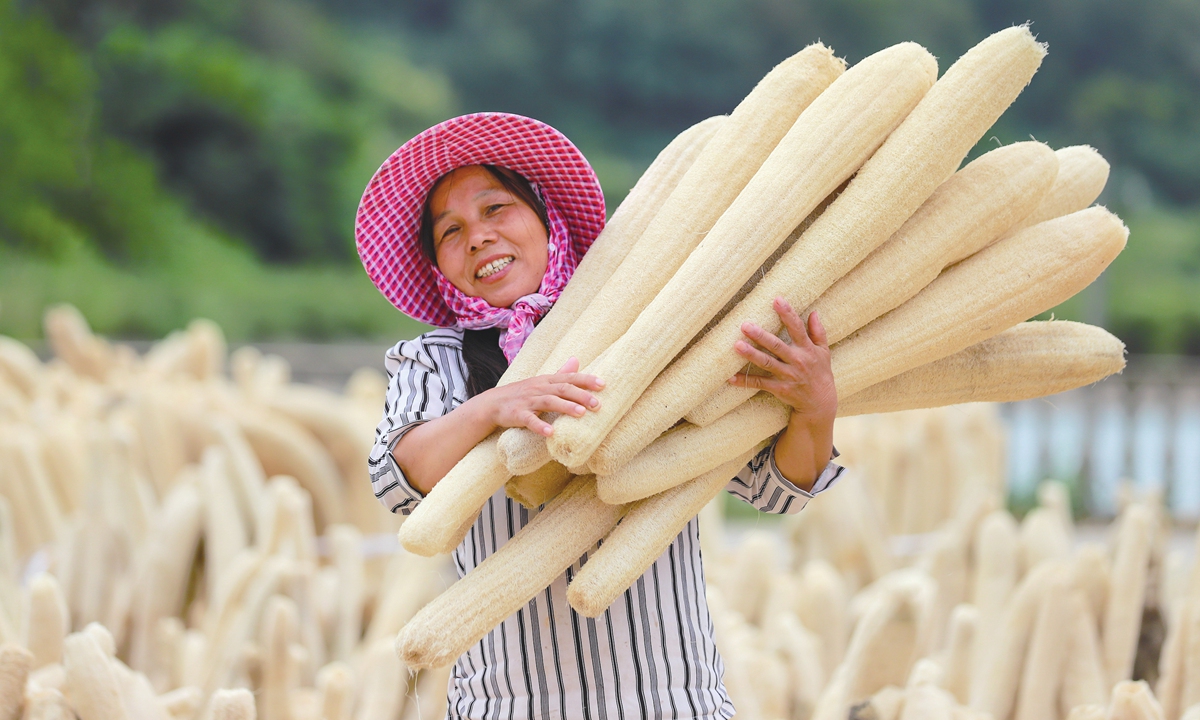
In Shangcheng County, Central China's Henan Province, the loofahs once lived a quiet life next to the stove - serving as kitchen scrubbers. Today they are a cross-border e-commerce star.
"We have built processing factories, design teams and unified procurement systems that link agricultural cooperatives and farmers across dozens of villages, turning sponge gourds - a traditional side crop - into a scalable, export-oriented industry," a sales manager at Yuangeng Longshang, a local producer and exporter of sponge gourd-related products, told the Global Times.
Processors in Shangcheng have developed more than 60 loofah product lines - ranging from bath sponges and kitchen scrubbers to pet toys and cultural-creative items - and sell them via Amazon, AliExpress, Temu and other platforms to more than 50 countries and regions, according to media reports.
In the first half of 2026, Shangcheng's e-commerce transaction volume of loofah-made products exceeded 30 million yuan, up 35 percent year-on-year. At present, the annual comprehensive output value of the loofah industry in the county has exceeded 100 million yuan.
Apart from sponge gourds, corn has also found a new way to become cloth.
"Unlike traditional synthetic fibers made from petroleum, the core ingredient of our flagship Sorona-based series comes from corn," Hong Boqi, general manager of Chuanyue New Material Co, a domestic cloth supplier, told the Global Times.
The process of making Sorona starts by fermenting corn sugars to extract Bio-PDO (a bio-based chemical building block, essentially a plant-derived version of the molecule used in certain plastics). This is then polymerized and spun into yarn and finished fabric.
The company has independently developed more than 300 Sorona fabric varieties, said Hong.
The firm is also exploring seaweed. Working with a domestic biotech partner, it created an "ice algae mud" functional fabric. Natural seaweed is finely ground and combined with a composite powder made from nephrite, then processed through a specialized spinning method. The finished textile is designed for recycling, reinforcing its green credentials.
Behind these advances lie years of patient research and development. Chuanyue invests about 4 million yuan annually in early-stage material development, covering the full journey from lab innovation to finished fabric, said Hong.
Innovative ways
Apart from being processed into industrial products, Chinese fresh fruits and vegetables are also processed in innovative ways to reach global consumers.
For example, Hainan Nicepal Industry Co is not simply selling fresh fruit. Instead, it uses advanced spray-drying technology to turn fresh fruits into fruit powders, concentrated juices, and not-from-concentrate (NFC) purees.
Pan Fengying, deputy general manager of the Hainan-based company, said that the company's output value reached 600 million yuan last year, and this year's target is 1.2 to 1.5 billion yuan, according to local media.
And in Yi County, North China's Hebei Province, fresh fruit that once spoiled quickly or fetched rock-bottom seasonal prices is now processed into "icy persimmons," which made exports easier.
In April 2026, the first batch of 15,000 persimmons was sent to Toronto, Canada. In the first half of this year, the sales volume of the ice-ripened persimmons in the county increased eightfold compared to the previous year; the annual production is expected to be 20 times that of last year, local authorities said.
Through controlled processes of de-astringency, sugaring and rapid freezing, the fruit develops a creamy, ice-cream-like texture while retaining its natural sweetness. Local authorities built a shared industrial park complete with standardized workshops, fully automatic production lines and large-scale intelligent cold storage, allowing micro- and small-sized firms to "move in without having to prepare for everything."
The China Agricultural Sector Development Report 2026, released in June, projected a pivot toward higher-value agricultural exports from 2026 to 2030. Categories such as processed fruits and nuts, frozen fruits, fish fillets and frozen vegetables are flagged for strong growth potential.
The message is clear: volume still matters, but value and differentiation matter more.
How did the "sudden" upgrade of the agricultural sector happen? Analysts pointed to two major reasons: pursuit of high-quality development and resilient supply chains.
China has emphasized high-quality development, guiding enterprises to focus more on quality over quantity. This has led to deep processing, brand building and new quality productive forces in the agriculture sector, said Zhu.
Zhu also noted that the speed and completeness of China's resilient supply chains are powering the transformation. Every link - from raw materials to finished goods, including processing, packaging, and logistics - is tightly connected.
。

B | AI摘要 福州晋安区王庄紫阳地块房屋征收13天签约率达99%。项目坚持党建引领,通过设立便民驿站、提供“一户一专班”服务等举措,兼顾效率与温度,目前正全力冲刺清零,未来将新建商品房及安置房。 日前,福州晋安区又一城市更新项目传来好消息——王庄街道紫阳公交场站及周边地块房屋征收自启动以来,截至8月17日,13天签约率达99%。

C | 从摸底丈量到集中签约、从首日封房“开门红”到“一户一专班”攻坚,这场征收既讲工作效率,更见服务温度。 紫阳地块征收签约现场。 一线扎下去 堡垒筑起来 此次征收面积约1.58万平方米,涉及205户。晋安区全面深化实施新时代“堡垒工程”,让党旗飘扬在征收一线。王庄街道第一时间成立征收指挥部,组建专项工作组,同步建立临时党支部,党员干部充分发挥先锋模范作用。 项目启动伊始,王庄街道即落实分片包户、责任到人机制,全员下沉入户走访。征收期间,晋安区委区政府主要领导赴一线慰问,勉励征收干部做实做细各项工作。

D | 一线干部用“铁脚板”换得群众信任:砌池社区网格员全面梳理矛盾隐患与弱势群体底数,一次次上门倾听群众诉求;乐东社区工作人员挨家挨户宣传,坐在居民家中用家常话算“经济账、长远账、安全账”;有的干部手部留置输液针,仍到指挥部参会调度,坚持“一把尺子量到底”。

E | 服务送上门 驿站暖人心 早在征收启动前,晋安区就明确提出,“加快设立便民驿站、提供帮办代办、矛盾调解一对一服务”。开到群众家门口的“便民服务驿站”,正是此次征收的暖心注脚。驿站整合养老咨询、水电气销户、法律援助、房屋中介等功能,为群众提供一站式服务。 特殊群体有保障。针对高龄、独居、智力残疾老人,五里亭社区主动对接周边合规养老机构;鼎屿社区工作人员帮七旬独居老人跑腿办水电销户、处理电动车问题;砌池社区主动协助困难家庭收拾打包。 封房首日,征收工作人员前置核验身份证与水电气销户回执,变“群众等”为“提前审”,提升办事效率。现场管控亦到位:落实班子成员分组带班值守,街道、社区、征收办干部全员驻场,王庄派出所、王庄城管中队增派人员维持秩序。

F | 防暑防雨、照明风扇、医疗驻点等一应俱全,做好现场服务保障。

G | 一户一专班 攻坚促清零 此次征收工作高效推进,得益于坚持党建引领,凝聚攻坚合力。一线干部始终秉持为民初心,把群众的“急难愁盼”放在心上,在政策允许的范围内,积极为群众争取利益,用心用情化解矛盾,赢得群众支持。

H | 当前,征收工作已进入扫尾阶段。王庄街道将继续落实“一户一专班”工作机制,破解剩余征收堵点,压实攻坚举措、细化推进方案,全力冲刺清零目标,推动项目全面完成签约封房工作。 此次征收地块将新建商品房、安置房,既回应群众改善居住条件的迫切期盼,也推动片区城市面貌提档升级。(记者 赵铮艳/文 王庄街道供图)。

I |
Current article:http://443.qiuergejiaolaiaozhuangshi.buzz/5w2lg/3vve.html
Published on:18:39:36